
Composition Science
The geometry of three-dimensional botanical architecture
Botanical Architecture
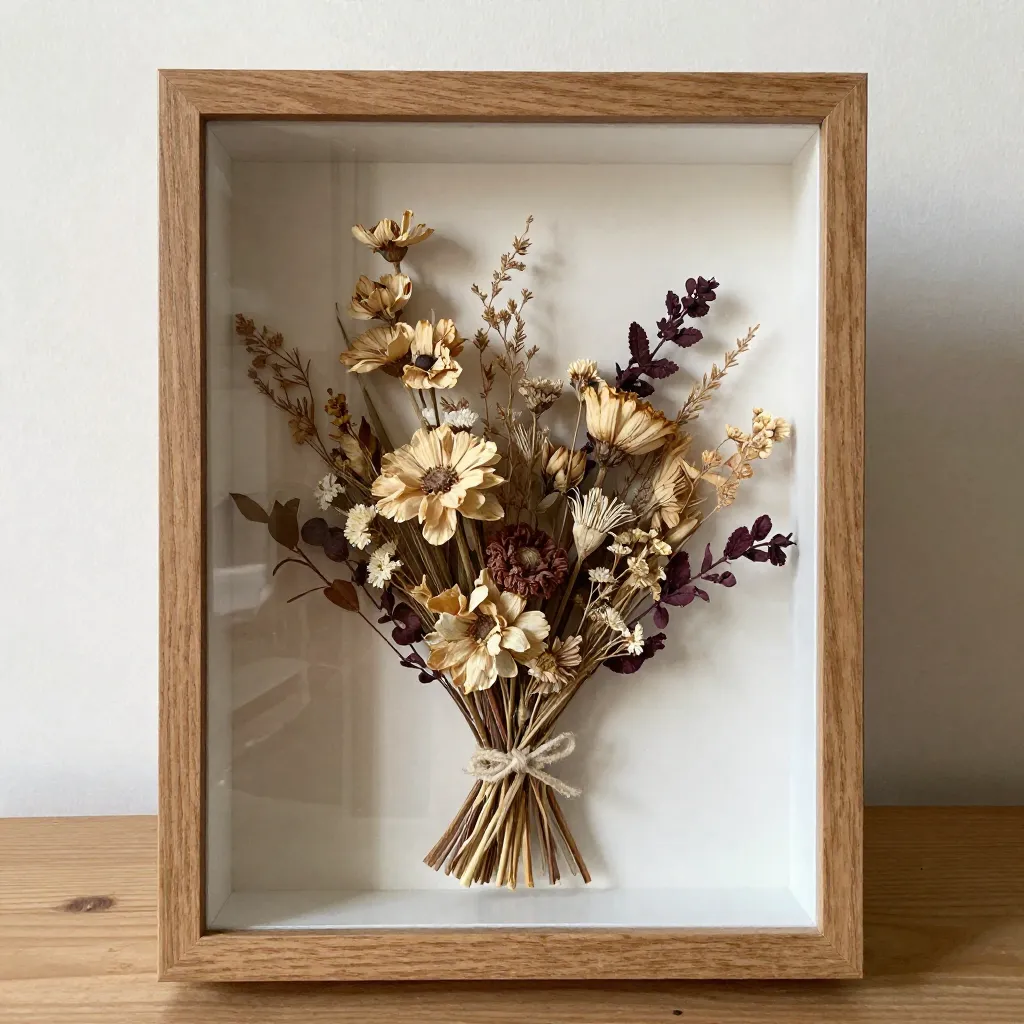
Shadow box framing transforms preserved botanicals into three-dimensional compositions. The arrangement of elements within a glass enclosure requires understanding of spatial relationships, visual balance, and depth perception. Each composition functions as architectural space where botanical elements interact with negative space.

Negative Space Balance
The relationship between occupied and empty space creates visual rhythm. Negative space allows individual elements to be appreciated while contributing to the overall composition's harmony.

Depth and Layering
Strategic placement of elements at different depths within the shadow box creates visual interest. Foreground, middle ground, and background layers work together to establish spatial hierarchy.

Stem Arrangement
The geometric arrangement of stems and branches follows principles of visual flow. Elements are positioned to guide the viewer's eye through the composition while maintaining structural balance.
Geometric Principles
Fundamental concepts that guide three-dimensional botanical composition
Rule of Thirds
Dividing the shadow box space into thirds both horizontally and vertically creates natural focal points. Key elements positioned at these intersections establish visual interest and balance.
Golden Ratio
The golden ratio provides a mathematical framework for creating harmonious proportions. This principle can guide the placement of elements and the distribution of space within compositions.
Visual Weight
Different botanical elements carry varying visual weight based on size, color, and complexity. Balancing these weights ensures the composition feels stable and cohesive.
Focal Points
Establishing clear focal points guides viewer attention. These areas of emphasis can be created through size, color contrast, or strategic positioning within the shadow box.
Depth and Presentation
Creating visual depth within the shadow box requires understanding both spatial arrangement and the presentation environment. The glass enclosure serves as both protection and a controlled viewing space.
Layering Strategy
Elements are arranged in multiple planes within the shadow box. This layering creates a sense of depth and allows for complex compositions that reward extended viewing.
Size Variation
Varying the size of botanical elements helps establish depth perception. Larger elements appear closer while smaller elements recede into the background, creating spatial illusion.
Frame Depth
The internal depth of the shadow box determines the range of layering possibilities. Deeper frames allow for more complex arrangements while shallower frames emphasize simplicity.
Viewing Angles
Three-dimensional compositions can be appreciated from multiple viewing angles. The arrangement should maintain visual interest and balance regardless of the observer's position.
Light Interaction
Natural and artificial lighting affects how preserved botanicals appear within the shadow box. Understanding light interaction helps in positioning elements for optimal visual impact.
Overlapping Elements
Strategic overlapping of preserved botanicals creates visual connections between elements while reinforcing the sense of three-dimensional space within the composition.